
Three months ago, a client in the education sector sent me a revision request I wasn’t expecting. I’d run the piece through my usual workflow, edited it, cleaned it up. The email said their team “had concerns.” Turns out their internal tool had flagged the piece. Nobody told me they were running it through a detector. Nobody told me what threshold they were working with.
That was the point I stopped guessing and started testing.
I took a 400-word B2B blog post with an identical pre-humanized version and ran it through six humanizers without any additional revisions between runs. I tracked before and after scores on the Walter Writes detector for each test, then compared the top scorers against GPTZero, Turnitin, and Originality.ai.
Walter Writes performed the strongest overall. Structure-level rewriting gets professional content to 8–23% AI on standard settings and 99%+ human on third-party detectors. texthumanizer.com and essayhumanizer.ai round out the top three for specific use cases. Everything else in this list serves narrow purposes that don’t hold up under real professional scrutiny.
1. Walter Writes: best AI humanizer tool overall, best for Claude watermarks
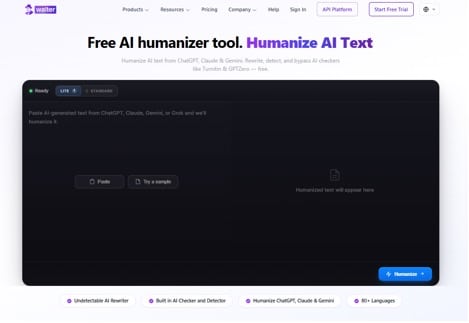
During the past twelve months, I’ve faced the Claude detection issue in client projects far more often than any other single issue. Major detection platforms evaluate Claude output differently than ChatGPT output, and most humanizing tools can’t capture these differences at the core: Claude places a watermark directly into the next-word probability distributions of its output, and that persists even through edited content.
Walter Writes reaches that layer. It employs a structural rewriting approach to modify the probabilistic architecture of how sentences are formed, breaking the watermark pattern where other tools continue to flag Claude-generated content.
I ran an unedited 400-word Claude-generated B2B article through the Enhanced version of Walter Writes. Before humanization: 91% AI on the Walter Writes detector. After: 9% AI.
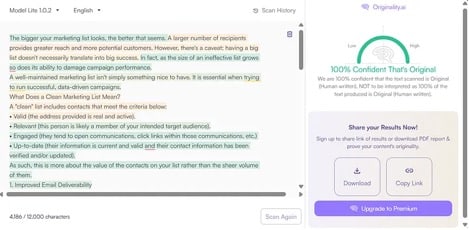
I ran the same test on a ChatGPT-generated article.
- Before humanization: 87% AI.
- After Standard rewrite: 23% AI.
- After Enhanced: 17% AI. (Screenshot)
The pattern holds across both models. For Claude-generated content specifically, Enhanced is the better starting point rather than building up from Standard.
Third-party verification of Enhanced output on Claude-generated content:
- GPTZero: 99% human
- Turnitin: 100% human
- Originality.ai: 99% human
The integrated detector is what makes this more than a humanizing tool. Generate rewritten content, identify flagged sections with the built-in detector, and re-run those specific sections, all in the same interface. No tab-switching, no copy-pasting between tools. For deadline work, that reduces production time significantly.
I put together a full breakdown of how this compares to other humanizer tools if you want the complete data set.
Free plan: Yes (300 words, no credit card required) | Paid from: $8/month | Try it: walterwrites.ai/ai-humanizer/
2. texthumanizer.com: consistent on structured content
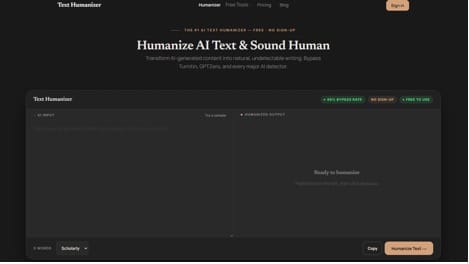
texthumanizer.com is much less polished than Walter Writes. It generated clean, usable output from the same 400-word B2B post, and I ran it twice to check consistency.
Test 1: AI input 79%, AI output 31% Test 2: AI input 83%, AI output 28%
What I was looking for: consistency across runs. If you’re getting wildly different scores on the same document between runs, you can’t build a reliable quality control process around it. This tool held. Both runs were close, which tells me the output is dependable enough to rely on.
The main shortcoming compared to Walter Writes is no integrated detector. You’ll need an additional verification step, which adds friction in deadline-heavy workflows.
Free tier: Yes | Best for: Structured professional content | Limitation: No integrated detection
3. essayhumanizer.ai: strongest on formal academic writing
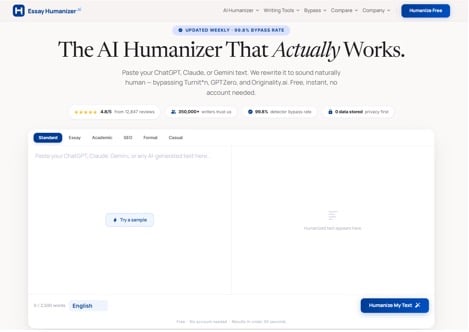
I ran this one specifically because of my coaching work. Students bring me academic writing: dense, formal, and argument-driven. That’s the context where most humanizers start to fall apart.
Results:
- Formal academic essay (91% AI input): 19% AI output
- Blog post (87% AI input): 41% AI output
Here’s the thing though: it’s calibrated for formal prose. When a casual blog post is fed into it, the output comes out stiff. When a well-structured argumentative essay goes in, the results are genuinely good. The tool is clearly trained on a different content profile than most general-purpose humanizers, and it shows in the academic results.
When my coaching students want to check their academic writing before submitting, this is the one I mention alongside Walter Writes. For B2B professional content teams, I’d still start with Walter Writes.
Free tier: Yes | Best for: Formal academic writing | Limitation: Poor performance with casual or conversational content
Other AI humanizer tools: brief rundowns
QuillBot
I ran the same 400-word post through QuillBot’s “highest-fluency” paraphrase mode. That resulted in a 64% AI score on the Walter Writes detector.
QuillBot-paraphrased content clears QuillBot’s own detector but doesn’t clear others. I covered why different detectors flag the same content in this breakdown from earlier this year. Each detector uses a slightly different threshold, so verifying output with the same tool that produced it tells you almost nothing.
Use QuillBot for paraphrasing and citation purposes. Don’t rely on it to humanize content for detection purposes.
Free | Not for: Bypassing AI detection
Undetectable.ai
Undetectable.ai is built specifically for humanizing AI content. Results are solid in many cases. The biggest drawback is inconsistency. I ran the same 400-word post through Undetectable.ai three times and got Walter Writes scores of 22%, 38%, and 19%. That’s a 19-point swing across three runs of identical content.
You can’t build a reliable quality control process around a tool with that kind of variance. The per-word pricing structure also becomes unpredictable at higher volume levels.
Paid from: $10/month (word-based pricing) | Best for: Occasional one-off passes | Not for: High-volume QC workflows
BypassGPT
BypassGPT was built to specifically target and defeat certain detectors. It cleared two of the three detectors it targets and scored 47% on Walter Writes. The content it produces doesn’t read like a person wrote it.
The craft still matters. If you’re looking for content that holds up across multiple tools and clients, BypassGPT doesn’t get you there.
Paid from: $6.99/month | Best for: Targeting specific detector thresholds | Not for: Content quality assurance
Which humanize AI is best?
Walter Writes, for professional use. Structure-level rewriting, integrated detection, three strength settings, and results that hold up on GPTZero, Turnitin, and Originality.ai. The 300-word free tier lets you test it on real content before committing to a paid plan.
For academic writing specifically, essayhumanizer.ai produces better results on formal prose than most tools in this category. texthumanizer.com is the most consistent second option for professional B2B content.
I get asked most often which humanizer to start with. If you’re creating professional content and need to verify it before delivery, start with Walter Writes and use the integrated detector to confirm the result. If you’re generating mostly academic content and want a comparison, add essayhumanizer.ai to your rotation.
How to 100% humanize AI text?
No tool guarantees 100%, and any tool claiming it is either testing against a narrow set of detectors or misrepresenting what that number means.
Here’s the thing though: what matters isn’t hitting 100%. It’s closing the gap enough for your actual use case. Walter Writes on Enhanced got to 8% on the Walter Writes detector and 99% human on the third-party tools I use most in my professional workflow. That’s the ceiling I’ve found in real-world testing, and it’s held up consistently.
Another variable that affects results: editing before you humanize. Every tool I tested performed better when given content that had already been partially rewritten by a human, not raw AI output pasted in unchanged. If you’re relying on your first draft to pass through a humanizer and expecting that to solve all your issues, you’re asking too much of the tool.
FAQ
Q1. Is there a free AI humanizer tool?
Ans. Walter Writes has a free plan: 300 words per run, no credit card required. texthumanizer.com and essayhumanizer.ai both have free tiers with usage limits. QuillBot is free up to a character limit, but it’s a paraphraser rather than a humanizer built for AI detection purposes, and the results reflect that.
Q2. Which AI can I use to humanize text?
Ans. Walter Writes, texthumanizer.com, essayhumanizer.ai, and Undetectable.ai are all purpose-built for this. Walter Writes is the only one with an integrated detector, which matters if you’re using humanization as part of a quality control process and want to verify the result in the same place.
Q3. Does humanize AI tools work?
Ans. Yes, consistently on professionally edited content. Less reliably on raw, unedited AI output. Every tool I tested performed better when the input had already been partially revised by a human before the humanizer ran. Walter Writes Standard rewrite took an 87% AI score to 23% on edited B2B content. The same tool on unedited raw ChatGPT output averaged around 35%.
Which humanizer you choose matters less than the state of the content you’re putting into it.
Q4. Can QuillBot humanize AI text?
Ans. QuillBot’s paraphraser reduces AI detection scores somewhat, but it wasn’t designed for this purpose and the results aren’t reliable. In my test, QuillBot-paraphrased content scored 64% AI on Walter Writes despite clearing QuillBot’s own detector at 100% human. The gap between how a tool scores its own output and how other tools score the same output is consistent across every platform I’ve tested.